The Biggest Liar…

On Saturday I might I watched The Biggest Loser. I didn’t really want to, I knew it would infuriate me and I was correct.

I never watched The Biggest Loser when it was showing. Not because I knew better, at the time I was very much steeped in diet culture & self loathing. It just wasn’t available on whatever tv channels I had at the time. So, for me, this was the first time seeing clips of the show. I felt rage, sadness and an overwhelming urge to intervene. The abuse those people were subjected to is appalling. Sadly I remember how commonplace that was at the time. I completely understand why the contestants signed up for this public humiliation.

For me, the documentary went way too easy on those involved in creating this programme. Right off the bat, Bob Harper (one of the show trainers) claims that he regrets nothing he did on The Biggest Loser. No one takes any real responsibility for the fact that they caused real and lasting harm. The film makers allow the producers, trainers and show Dr to dodge accountability with pathetic excuses. I felt that the documentary ultimately reinforced the message of the show; the ends justify the means.

The creators of The Biggest Loser (BL) admit that they purposely used sensationalist tactics to attract attention. They knew the connotations of the name and played on it. They wanted people to tune in thinking they could judge these ‘fat losers’. They encouraged the trainers to be outrageous, they wanted contestants to throw up, cry etc. They knew the vile ‘challenges’ were cruel and unnecessary, but it made good television. They excused this exploitation by claiming that they were improving people’s health. In other words, all was acceptable in the name of thin. Everyone involved knew they were hurting people. Dr Robert Huizenga, the programme’s medical advisor told them so. He claimed that he regularly met with the trainers to explain his recommendations. He also admitted he was aware that they ignored him; they cut the calorific intake to dangerous levels and over trained people to the point of injury. Dr Huizenga tries to paint himself as caring medical professional who was helpless in his attempts to prevent harm. In reality he had a duty of care, he should have left the show and reported the dangerous practices. He could have stopped taking their money and spoken out at any time. He didn’t, he continued to profit from damaging fat people. Not only the people on the show, but all fat people who were impacted by the message of the BL.

That gist of that message was that fat people are lazy and gross. The ‘temptation’ challenges reinforced the idea that fat people can’t control themselves. The cruelty of those challenges is ignored in the discussion, the participants were forced to choose between gorging on ‘junk food’ or missing visits with their families. The footage included in the documentary shows participants crying whilst eating pizza slices; their suffering was entertainment. The show revelled in degrading the fat competitors. Tasks that made them build food towers with their mouths, trainers screaming, participants set against each other. Placing people on extreme diets, working them past exhaustion daily and then capturing their disputes and meltdowns on camera is repulsive. Worse still is the soul destroying message the trainers rammed home. Once the abuse was concluded they would tell participants that it was for their own good. I only shouted because I care about you, I knew you could do it, I didn’t want you to give up. Then the nail in the coffin, ‘don’t make me have to do that again’. The lesson to the participants and the viewing public? This is your fault. It’s your fault you are fat. It’s your fault you don’t apply yourself. It’s your fault that I had to abuse you.

All of this aside, the BL’s main claim, that they were improving lives, was obviously not true. Even if weight loss was a magic cure all, their process was clearly unsustainable. No one can live on 600-800 calories p/d forever. People with jobs, families and lives cannot train for 8hrs a day, everyday. It doesn’t take a genius to conclude that as soon as participants return to their regular life, they will gain weight. I have partaken in enough crash dieting to know how quickly the weight returns. One of the former contestants in the documentary talked of how he asked the BL to set up aftercare and was denied. Other contestants reached out to seek help for injuries sustained on the show and were ignored. Cut to a producer explaining that they didn’t have the budget for aftercare. Plus he didn’t think it was their responsibility. They were making a tv show; what happened after wasn’t their business. Meanwhile we learn the BL franchise earned billions. They licensed their name to every product you can imagine. Further exploiting vulnerable people desperate to lose weight. It was a cash grab and fat people were paying for it.

The only entirely critical voice in the documentary is fat activist, Aubrey Gordon. Her contributions are insightful and impactful. Alas, there was not nearly enough of her. Even the former BL contestants who were critical of the show were still heartbreakingly steeped in fat phobia. They were still seeking weight loss, still blaming themselves and still felt they weren’t good enough. The evidence of the consequence of extreme dieting was somewhat skimmed over. Studies on broken metabolism, life threatening conditions and even Bob Harper’s heart attack are treated as incidental. They place no importance on the fact that a man who adhered to the supposed ideal diet and lifestyle had a massive heart attack at 52. As if that information doesn’t disprove the central argument of The Biggest Loser.

The documentary concluded with more diet culture propaganda. They give obesity stats without ever mentioning that those numbers are based on BMI. A measurement that has been conclusively proven to be inaccurate. It’s a non scientific, racist scale. The documentary makers allow the show creators, trainers and Dr to claim good intent and even positive results. Their hearts were in the right place, they say. They made some people thin. Damn the ramifications. After all, anything is better fat.

If you like what I do you can support me on Patreon.

Something’s gotten hold of my heart…

As I have mentioned, more than once, I having been some extra health issues. Yesterday I saw my GP and she gave me some answers. Unfortunately they were neither want I expected or wanted them to be.

It seems that long covid has become permanent a more of a problem. The tachycardia and breathlessness that I have been experiencing since having covid in Oct 2020 have been significantly worse over the last few months. I am breathless after a few steps. My head spins the minute I stand up. I faint daily. My heart tries to burst out of my body and my chest hurts. All the time. In the past when I felt like this it has been related to aneamia & b12 deficiency. I have had lots of issues with really low haemoglobin and although I never get to ‘normal’ my bloods aren’t dangerously low at the moment. We did a bunch of treatment, but I didn’t feel any different. I had some more tests, kept a symptom diary and recorded my heart rate a few times a day. My GP’s conclusion is that covid has damaged my heart function.

She is fairly certain that I have some kind of heart arrhythmia or PoTS. The prospect of neither fills me with joy; PoTS in particular is very frightening. I have been referred to cardiology and more tests will ensue. I really expected these issues to be related to existing conditions. It was a shock to be presented with a possible new diagnosis. The thought of these symptoms not improving or even worsening is overwhelming. I have enough health problems. I don’t need anymore.

All of this to say two things. Covid is no joke. Even if you get through the initial illness ok, there is no telling what it will do to your body. Please don’t pretend this pandemic is over. There are still huge communities that of sick and disabled people who are high risk. Even healthy people can be really badly effected. Wear a mask, keep your distance, wash your hands! None of these things are hard to do. And, I am feeling scrambled. I don’t know how to process this new information. Physically I am a mess. I’m very apprehensive of what is to come & my head is all over the place. So, please bear with me if things get inconsistent around here.

close up of ly’s  face wearing brightly coloured mas and thick black glasses

If you enjoy my writing you can support me on Ko-Fi

Wake me up inside…

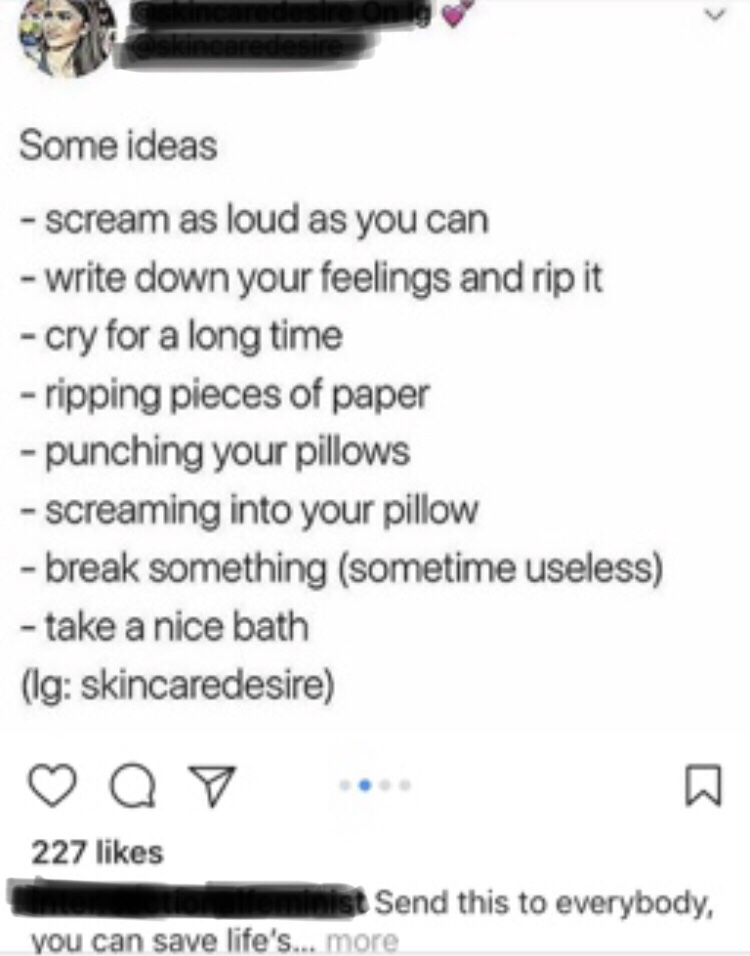
Today I saw another one of those social media that purports to offer alternatives to self harm. This time the post also claimed that sharing this information would save lives.

I’m just going to be completely honest, this bull isn’t saving any lives. These are not credible alternatives to self harm. They will not stop an ill person from hurting themselves. They don’t solve the problem of why a person might feel the need to hurt themselves; they don’t even address it. In fact, in some cases they reaffirm the idea that hurting yourself is a good coping mechanism (just so long as you do it in a socially acceptable manner).

I’ve talked & written about why these suggestions are insulting until i’m blue in the face. I see others giving excellent arguments against such advice & yet this sort of thing is still the only information disseminated in the mainstream. So, I thought I’d try to talk about what actually can help one refrain from hurting oneself.

My suggestions are more complicated & time consuming & bloody hard. They don’t lend themselves to becoming a jaunty list to share in Twitter. The grim reality is that self harm is a grind and so is quitting.

Blood stained foot

For me the first step in getting anywhere close to stopping was understanding why I started in the first place. I truly believe understanding why a person self harms is crucial to recovery. Self harm isn’t the illness, it’s a symptom of it. From the outside identifying what is distressing you might seem simple, but trust me, it isn’t. There can be layers of trauma & hurt. A person may have a lifetime of issues woven into a complex fabric of pathologies. Picking that apart is intensely painful. Having pulled on that dangerous thread, you’re going to have to find ways address those underlying problems. They don’t simply disappear under a bright light. It takes time, professional guidance & huge bravery.

And that’s just the beginning. Next you have discern what you get from self harm; how is it helping you cope. What function is inflicting pain serving. Again, this is no simple puzzle to solve. My self harm had many roles. I was punishing myself, I hated the body that had failed me, I was avoiding emotions I couldn’t cope with, the blood was cathartic, I became addicted & a multitude of other reasons. Predictably totting up all the pay offs doesn’t negate them. There is more work to be done. One must weigh how healthy each function is and decide if it enhances ones life. For instance, probably not a great idea to be continually forcing myself to do penance, however it is a good idea to not be completely overwhelmed by sadness. You must find away to live without the unhealthy whilst also establishing new mechanisms to maintain essential uses. Of course all the time you are working away at your inner self you are dealing with addiction. Self harm is habit forming. So, your journey of self discovery/healing/madness has a background of overwhelming urges & powerful compulsions. To begin with you have to fight the full force of addiction every single moment of every single day. Plus, of course, everyone has their own additional problems to throw into the mix. Maybe you have co morbidities or financial problems or a family you’re trying not mess up with your illness. Life doesn’t stop when crazy calls.

None of this easy. It does not and cannot happen over night. It involves breaking down long held beliefs & opening yourself up to being scared and vulnerable. This post is just a simplified version of a process that takes years. It involves psychiatric professionals, medical intervention, medication, therapy, a support network, a&e visits & most of all trying to be honest. I understand why it’s easier to pretend you can draw on your skin or scream at a wall until you’re better. It is terrifying to a/ begin trying access the kind of intensive help needed & b/ expose yourself to pain you’ve been desperately trying to suppress. Believe me, selling yourself & others a lie is not the answer.

The truth is there are no tips & tricks for beating self harm. There is no magic fix or complete cure. I look at it like any other addiction. I will probably always want to cut, I have to do whatever I can not to. No amount of extremely cold water will ever change that harsh fact. When it comes right down to it, for me, the driving force in abstaining is knowing that I want other things more than I want to pick up that scalpel. Oh & sheer will power. I couldn’t have come to that realisation without more than a decade of therapy. I absolutely could never have exercised this level of control over the voice in my own head without putting in all that work.

I’m not going to say everyone’s story is the same as mine. I can’t guarantee that you can ever get completely better. I’m not. I can only offer you the hard truth of my experience & my certainty that there aren’t any shortcuts. Don’t share false hope. Let’s be honest with people who really need it. Trying to quit self harm is a nightmare, but there is hope that you’ll wake up.