Mental Health Platitude Week…

It’s National Mental Health Awareness Week again. Regular readers will probably have spotted how I feel about this sham, but for the avoidance of doubt I’m going to go at it once more. I ask you to forgive my lack of finesse. I’m riddled with infections, haven’t slept & more than a little frustrated with the subject matter.

Some of you may be thinking, wait, raising awareness about mental health is great. You are of course correct, but this week (& most mainstream MH campaigns) is just lip service. At best it’s platitudes & at worst it’s dangerous. If you check the hashtag on social media you’re going to see a lot of posts extolling the virtue of talking about your troubles. Talk will apparently cure all that ailes you. Ask for help & you shall receive. Pro Tip, It won’t & you won’t. 

On the help front you’ll be up against the limitations of the NHS. Cuts to mental health services have been particularly brutal. Even if you have the good luck to access a Gp who takes you seriously & correctly refers you in a prompt manner, your wait will be long. What’s worse is that the correct help is unlikely to be at the end of your wait. A shocking lack in resources of every kind results in most people being offered short courses of cheap therapies like CBT. It will come as no surprise that with mental illness one size does not fit all.

 Even in acute circumstances there are no psychiatric beds available. Many people have to travel long distances to access inpatient psychiatric care. Meaning they are far from family, friends & comforts in their darkest moments. If you’re a child or adolescent those resources only get scarcer. So, that’s frightened children waiting in misery to access services that may be of no use to them anyway. All of which is a far cry from just talk & salvation awaits. 

As depressing as all that is I haven’t even broached the fact some people never get as far as a waiting list. For many there is no sympathetic ear. Their gigantic leap of faith is met with ignorance. Employers do still discriminate against the disabled. There are still Dr’s who will tell a person to pull themselves together. The worst stigma I ever faced was from medical professionals. All of which means awareness is great, but money is better. Proper funding is the answer to our mental health crisis & it is that is what we should be talking about. 


The money problem doesn’t end with NHS funding. Our government is trying to eradicate disability benefits for mental illness entirely. The process of applying for PIP or ESA is exhaustive. The categories for qualifying are constantly shrinking. Our benefits system currently subjects vulnerable & very sick individuals to the most humiliating process in order to survive. That mental illnesses are purposely targeted for exclusion is government sanctioned stigma. Ah, I hear you cry, we do need awareness.  Well here’s the thing, we don’t need the bullshit being touted by the mainstream orgs. All those articles about exercise & healthy eating & a hot baths & nice cups of tea are just shoring up that stigma. The idea that mental illness can be cured by any of those things minimises it’s very nature. It encourages the notion that people with long term mental health problems just aren’t trying hard enough. That in turn legitimises the governments disgusting witch hunt. 

And we’re right back to my original point. Awareness is fine, but real change is the key. If you truly want to make a difference you need to tell your elected representatives that mental illness is a key issue for you. Sign petitions, attend marches, get informed. Read the difficult articles. By all means challenge stigma when it crosses your path & listen to anyone who chooses you as a confident. Do all of those of things, but I want to be clear, there is one crucial thing that will hand more impact than anything else, DO NOT VOTE TORY. 

Transforming mental health through research…

I have struggled with mental illness for most of my adult life. I have written here before about the difficulties I have faced & the massive impact my illness has had on my life. As painful as my issues have been I have always been incredibly grateful that I faced them as an adult. The growing crisis in children & adolescents mental health care demonstrates that not everyone is so fortunate.

Currently 3 children in class have a diagnosable mental health issue. Despite early intervention being a key factor managing mental illness, children often do not have access to specialised services. Many young people are trying to deal alone with problems of a magnitude that defeat adults.

MQ Mental Health Infographic[754]1.png 

There has been much talk of mental illness reaching parity with physical in terms of funding & priority. However, there is still a vast shortfall in mental funding. It is clear that the descripency in care for young people facing mental illness has long term impact on not only individuals, but also society at whole.
The only way to defeat the stigma attached to mental illness is to treat psychiatric & medical problems equally. We must make it easier for children to not only talk about mental illness, but to actually access the treatment they need.

MQ Mental Health Infographic[754]2.png

As I said there have been moves towards redressing this shortfall in mental health funding & research, but it has to be solidified. In order to guarantee this sustained political will has to be garnered.

If you feel, as I do, that this is a critical public health issue please get involved at http://www.mqmentalhealth.org

Love your curves & all your edges…

January has been a bit of a fail on the outfit post front. I wasn’t out all that much & I had no photographer when I was. I aim to do better this month. Starting right now.

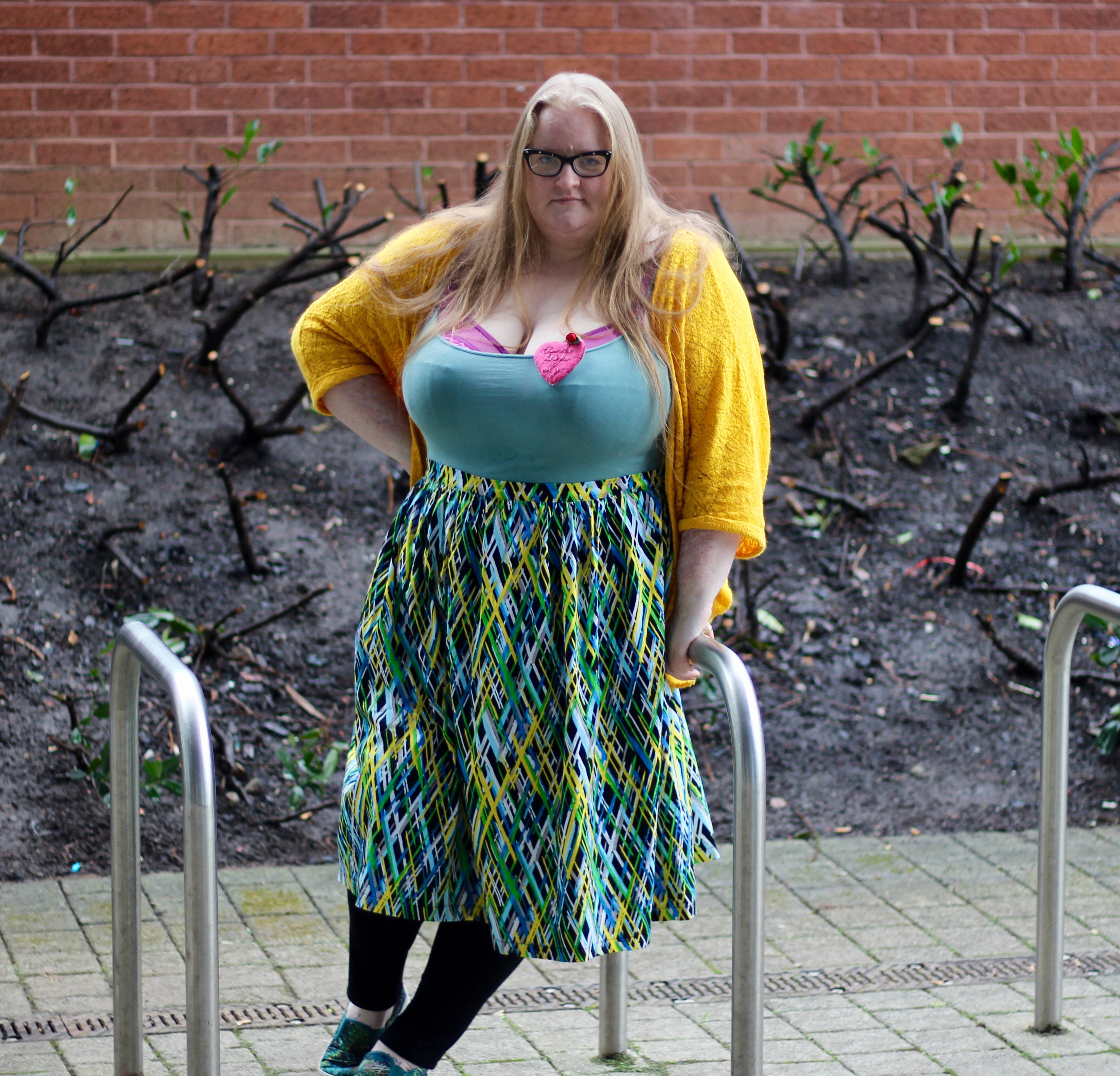
I wore this outfit to lunch with my bestie a couple of weeks ago, but didn’t get any good pics. I really did like it & recycled the look for a film with my Sis. 


This swing skirt is too big now as the combination of going vegan & taking metaformin has caused me to inadvertently lose some weight. It still looks cute if I pin it a little & I think I’ll try getting it taken in. Anyway, the print is fresh & with a simple vest it shows of my ins & outs nicely. 


Skirt – Lindy Bop

Cardi – Primark

Brooch – Posie Grenadine (Etsy)

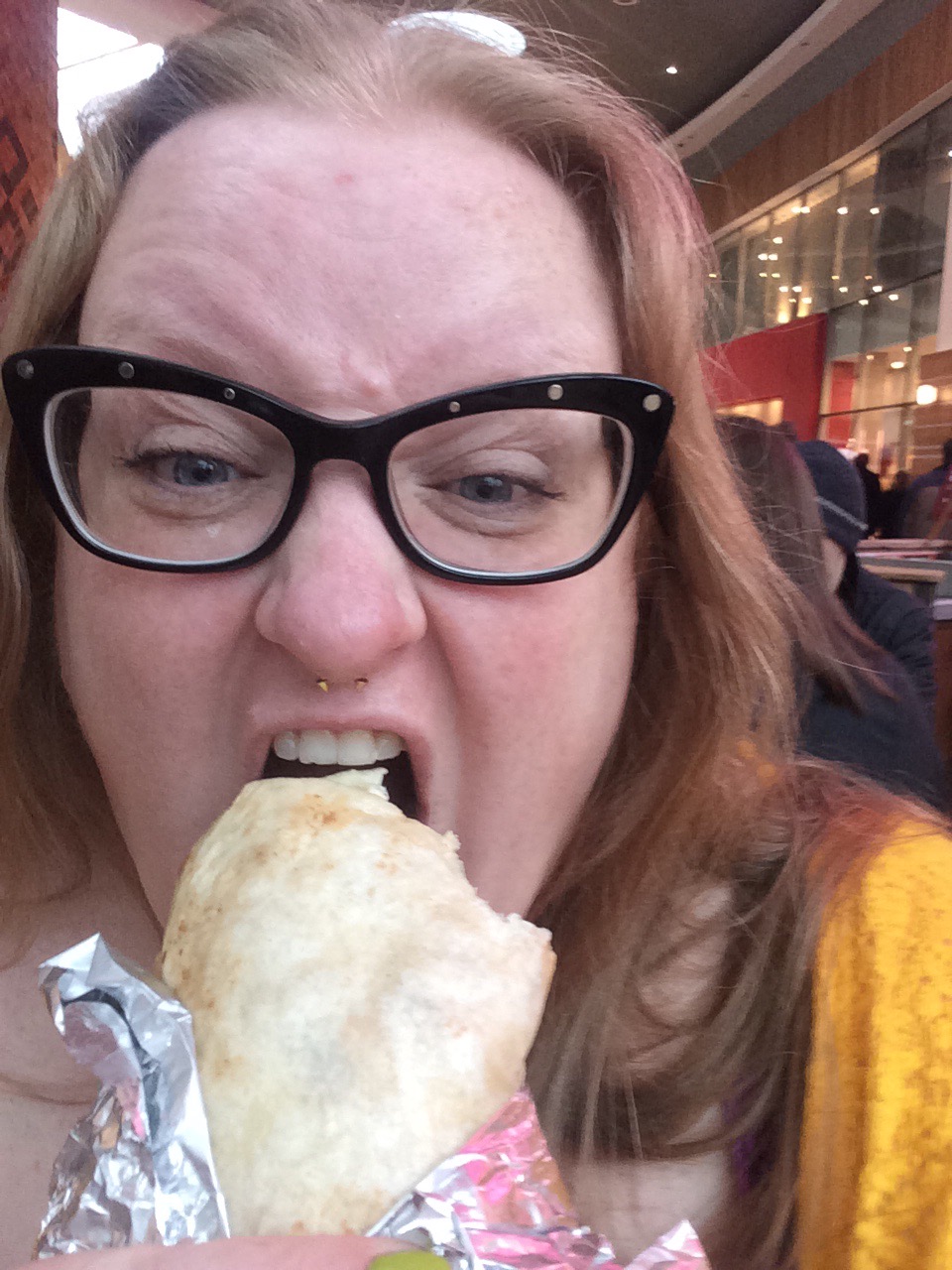
I stuck my favourite brooch on for a touch of sass & was good to go. We had a quick, but yummers lunch at Tortilla. Great option for vegans, big thumbs up. 

We saw Split, which could have been a fairly entertaining thriller had it not gone down the tired ‘crazy’ route. The vicious killer has dissociative identity disorder & of course has alters who want to abuse people. This is basically the only way DID is represented by popular culture & is so stigmatising. It’s a shitty trope that needs to stop. In short, I’d suggest giving it a miss. 


Amusing outtake. 

On the plus side…

Fatigue is getting the best of me this week. I am out of spoons, but I don’t want to be out of words on this blog. Hence, I wil be sharing some short pieces I have written for other publications. I hope you find them as absorbing as my usual content.

First up a piece on how body shaming & fat stigma makes plus size infertility an even bigger challenge.

Infertility is heart breaking affair for anyone who wants to have a child. With the NHS now reporting that 1 in 7 couples have difficulty conceiving, infertility is more common that we realise. Thankfully many people in UK will be able to access fertility treatment via the NHS. However, some people are not deemed suitable for treatment. One of the groups who may be denied access are those categorised as clinically obese.

Women with a BMI over 30 are routinely refused fertility treatment. Drs advise them lose weight before they can be referred to a specialist. There are a number of issues with this policy and some are tied in with the way society as a whole views fat people. Let’s begin with index used to measure if a person is obese. Body Mass Index (BMI) has been widely discredited. The index has a number of problems including the fact that BMI does not differentiate between muscle & fat. Hence, people who are fit & have healthy body fat can be classified as obese. Another issue is that BMI does not recognise difference in body shape. It is well established that those who carry their weight around the middle (sometimes known as apple shaped) are at much higher risk of health complications than those who carry excess fat around their hips (pear shaped) [1]. Thus women with very different shapes & risk factors can be labelled with the same BMI. Perhaps the biggest failing is that BMI  does not always change with lifestyle alterations. A person may make significant changes to their health without necessarily losing large amounts of weight. Partaking in regular exercise and switching to a balanced (but not calorie focused) diet will have a huge impact on a person’s wellbeing. Sadly, BMI would not recognise these positive changes unless there is also weight loss. This can put women in the position of focusing on how much they weigh rather than how their lifestyle impacts their wellbeing. BMI uses an arbitrary scale to calculate’ health. Since a person’s health can not be determined on their weight alone; it is bound to fail.

Of course, there are also questions to be asked outside the clinical failings of BMI. It is important to note that there is no official policy on women who are under weight. Despite the fact that being ‘too thin’ can have a bigger impact on a woman’s fertility than being ‘too big’. The medical community appear to jump to the conclusion that fat is always bad. A notion that is reflected in society & that causes plus sized women to face wide spread discrimination. It is estimated that half of pregnancies in the UK have obese mothers. Yet studies show that only 5% of admissions to neonatal units and 4% of preterm births could be avoided if all pregnant women had a ‘normal’ BMI at the start of pregnancy [2].The implications is clear, overweight woman are regularly having healthy pregnancies & deliveries. Still the overwhelming message from the medical community is that obese women automatically have  high risk pregnancies.

We must also look at the origins of the BMI scale. It was developed in the 19th century by a Belgian Mathematician. The formula was intended to be used as an easy way to measure populations, not individuals. It was developed for the purposes of statistics not measuring individual health. BMI is not a reliable scientific measure. It is astounding that it is still in use.

The most worrying part of this protocol is that women are often not even referred to a fertility specialist until they capitulate on the weight loss issue. This means that women who have specific medical problems interfering with conception are forced to delay interventions that could solve their problems. The bottom line is that women who are classified as obese get a raw deal. Underlying prejudices seem to be making an already distressing issue much harder of plus size women. Infertility can make women feel powerless and incompetent. When you are fat, those feelings are increased by the prevailing impression that your weight is to blame.

1 Mayo Clinic
2 Public Health England, Maternity obesity and pregnancy outcomes.

If you like what I do you can support me here or on Patreon.

You should see my scars… 

Today is self injury awareness day. I’ll be honest I’m fairly jaded about awareness days. Especially those of the mental health variety. Too often they seem to me to be highlighting the wrong things. Today hasn’t broken the mold. Almost everything I have read in relation to self injury awareness day (SIAD) has focused on the usual stereotypes. Some have just missed the point entirely. So, I have decided to share a little of what goes on in the head of a person who is hurting themselves Specifically, this person. 

I don’t fit the stereotypes. I didn’t hurt myself as a teen. I wasn’t bullied & had a picture perfect childhood. I was never desirous of attention or seeking care in the form of dressings & kind medical professionals (ha!). I’m not stupid or dangerous or crazy. I have fought this battle as an articulate, independent adult. I’ve hidden wounds & scars through university & work alike. I kept a secret shrouded in stigma. Constantly confronted with the idea that my problem was one that should only face little girls. Shamed by the opinion that I am an incompetent drama queen. 

I am none of the above. Rather, I am woman who suffered trauma that altered my life. In the depths of anguish I stumbled upon a solution; a maladaptive survival technique. An act sought out to gain control when I felt powerless. Lamentably, my source of control rapidly overtook me & established dominion. Self harm is so complicated. It’s scope is different for each individual. For me, it become all encompassing. My daily thoughts circled around if/when I would cut. Being proficient was paramount. Every cut had to be ‘better’ than the last; I sought deeper wounds, more blood, more damage, more more. Self harm entangled itself into my identity. 

Admitting that & asking for help felt like relinquishing part of my self. Not only was I facing the loss of self harm, but also the strong, capable parts of myself that made me feel worthy. Admitting that I could no longer cope was the most vulnerable I have ever been. Believe me when I say that to face stigma & prejudice in that state is crushing. To gather all your courage to tell a therapist the ugly truth & be faced with a ‘just stop’ attitude is soul destroying. Equally dragging your blood soaked self to a&e only to be treated with disgust can break a person. That the is the problem I & many others most need addressed. 

I believe SIAD should be about acknowledging the complexity of the issue. We should be focusing on changing the attitudes within the medical profession. Yes, let’s educate our communities about mental illness, but let’s also change the entrenched attitudes within the institutions that have the power to destroy lives. The worst stigma I have faced has been from dr’s & nurses who ought to have known better. Stigma is never positive, but I’ll take a hundred ignorant strangers over one cruel dr. Being unable to safely access treatment can kill. We need to take the fight to that front line. 


If you like what I do you can support me here or on Patreon.